

Product Technical Parameters
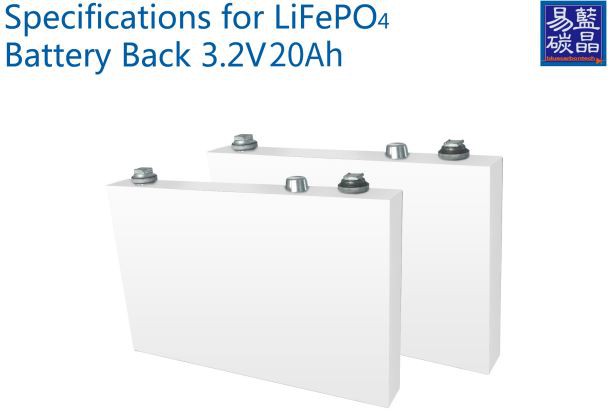
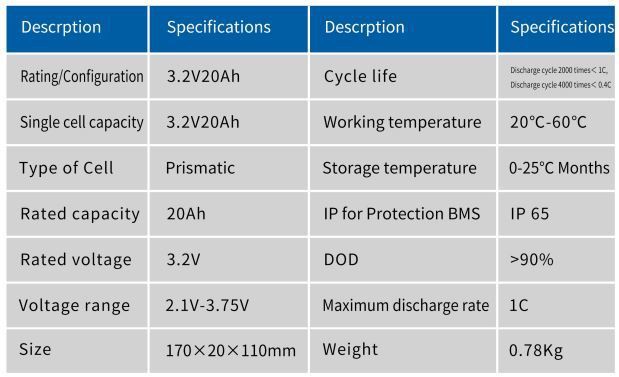
| Model | BCT-20Ah | Cycle Life | Discharge cycle 2000 times< 1C, Discharge cycle 4000 times< 0.4C. |
| Rating/Confifiguration | 3.2V/20Ah | Working Temperature | 20℃-60℃ |
| Single Cell Capacity | 3.2V/20Ah | Storage Temperature | 0-25℃ 6 Months |
| Type of Cell | Prismatic | IP for Protection BMS | IP 65 |
| Rated Capacity | 20Ah | DOD | >90% |
| Rated Voltage | 3.2V | Maximum Discharge Rate | 1C |
| Voltage Range | 2.1V-3.75V | Weight | 0.78kg |
| Size | 170×20×110mm |


Blue Carbon Technology Inc. designs, manufactures and markets of solar module products for residential, commercial and industrial application worldwide. We put customers' needs first, and we are devoted to progress, innovation and ethical choices. Solar energy is about empowerment, and that's something we take very seriously. Our mission is to deliver innovative photovoltaic technologies for building integration to generate renewable solar electric power. Our hope is to secure the health of our planet for future generation by transforming our infinite supply of sunshine into a practical energy for humanity.
What we can do for you:
1. Wide range of lithium batteries (3.2V-48V, 5Ah-200Ah) to choose from.
2. Use high quality a grade prismatic cell. More than 5000 cycle life. Up to 15 Years lifespan.
3. Offer 5 years warranty.
4. Fast lead time. QTY 100-500pcs deliver in 7 days, QTY 500-1000pcs deliver in 14 days.
5. Help you to choose the most cost-effective shipping way.
Some knowledge you should know
Lithium battery repair principle
Repair principle one: the metal surface of lithium battery used for a long time will have a certain degree of oxidation, resulting in bad contact between mobile phone battery and mobile phone, lithium battery use time becomes short, but with eraser or other cleaning tools can wipe the surface of the rusty material, let the battery and mobile phone contact better.
Repair principle two: low temperature can make the lithium battery internal electrolyte change, promote the battery has just been frozen chemical reaction. The use process of lithium battery is actually a charging and discharging process. During this time, the negative and positive charges in the battery collide with each other. Batteries become less and less useful because at normal room temperature there is more kinetic energy inside the electrons, so the batteries are active and leakage is relatively frequent. When a lithium battery is placed in a low temperature environment, the micro structure of the lithium membrane and electrolyte on the surface of the lithium battery, as well as their interface, will significantly change, leading to the temporary inactivity in the battery and the reduction of leakage current. So after recharging, the phone's waiting time will increase.
The recycling life of lithium batteries is about 600 times. If the charge is repeated for many times, the thermal motion of the molecule will gradually destroy the micro structure of the internal molecular arrangement, and the charge storage efficiency will gradually decrease. "The freezing process is easy to destroy the original internal structure of the battery, which may increase the charge capacity in the short term, but may not be effective in the long term." Once the micro structure inside a lithium battery is destroyed, it is impossible to recover completely, and long-term use of this method will accelerate the depletion of cell phone batteries.
Classification of lithium battery, reserve battery and standard battery
The lithium battery
A battery with lithium as its negative electrode. It is a new type of high - energy battery developed after 60 s. According to the different electrolytes used are divided into: 1, high temperature molten salt lithium battery; 2. Lithium organic electrolyte battery; 3. Inorganic non-aqueous electrolyte lithium battery; 4. Solid electrolyte lithium battery; 5. Lithium water battery. Advantages of lithium batteries are high voltage, high specific energy, long storage life (up to 10 years), high and low temperature performance, can be used at -40 ~ 150℃. The disadvantages are high price and low security. In addition, voltage lag and safety problems need to be improved. The development of power batteries and new cathode materials, especially the development of lithium ferrous phosphate materials, is of great help to the development of lithium electricity.
Reserve batteries
Water-rechargeable batteries can be activated in two ways. One is to store the electrolyte and electrode separately, and then to activate it by injecting the electrolyte into the battery pack before use, such as magnesium seawater battery, reserve chromic acid battery and zinc silver battery, etc.. The other is to use molten salt electrolyte, the electrolyte is not conductive at room temperature, before the use of heating agent will quickly melt the electrolyte and activation, known as a thermal battery. The battery can use calcium, magnesium or lithium alloy as negative electrode, KCl and LiCl's low eutectic as electrolyte, cacRO4.PBSO4 or V2O5 as positive electrode and zirconium or iron powder as heating agent. The whole seal structure can be stored for a long time (more than 10 years).
Standard cell
The best known is the Whiston standard battery, which comes in saturated and unsaturated versions. Its standard electromotive force is 1.01864 volts (20℃). The voltage temperature coefficient of the unsaturated type is about 1/4 that of the saturated type.
Hot Tags: byd 3.2v 20ah lithium prismatic battery cells, China byd 3.2v 20ah lithium prismatic battery cells manufacturers, suppliers, factory