Photovoltaic water pumping system and composition
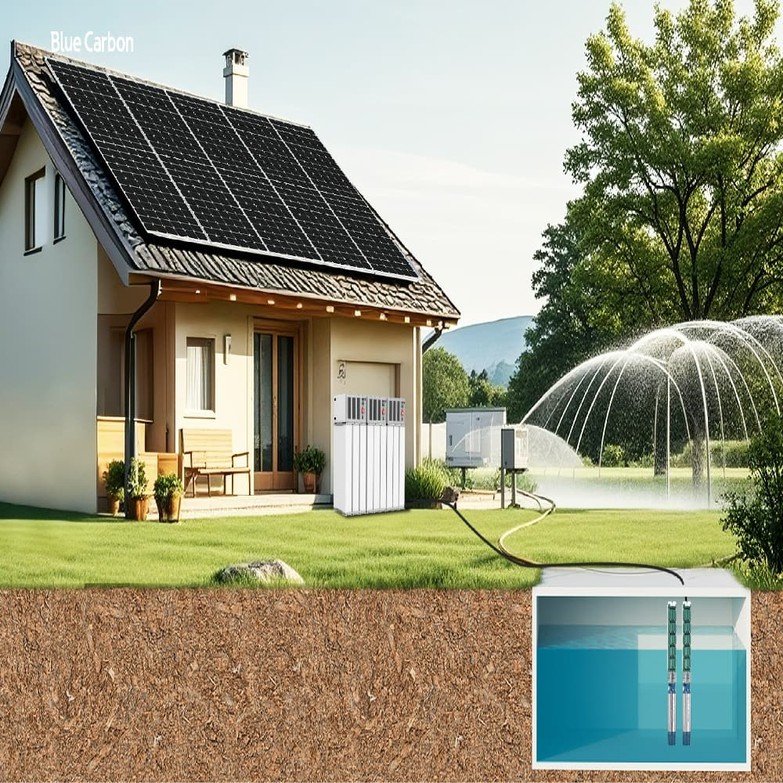
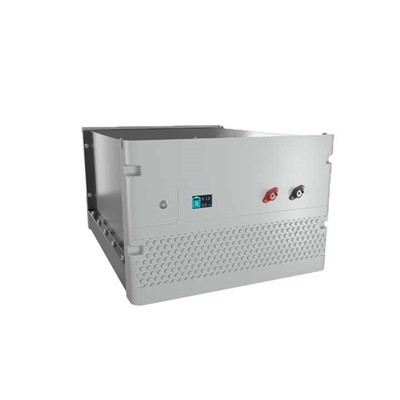
Blue Carbon Photovoltaic water pumping system is mainly composed of photovoltaic panels, photovoltaic storage machine, inverter and water pump.
The PV pump system utilizes solar energy to drive the water pump to extract water from deep wells, rivers, lakes, reservoirs and other water sources.
The photovoltaic pump utilizes the sun's long-lasting energy without the need for diesel fuel, power grid, or manual duty, which saves manpower to a large extent.
The role of photovoltaic water pumping system
In the past, water pumps were usually driven by electric or diesel motors for water supply, but electric and diesel genset-driven water pump systems not only have high operation and maintenance costs, but also consume fossil energy and damage the ecological environment.Nowadays, photovoltaic water pumping system can be used for water supply, as long as the light resources are abundant, the underground or the surrounding rivers and lakes are rich in water resources, using photovoltaic water pumping system for water supply, it can be used for agricultural irrigation, sand treatment, urban water features, water for life and other fields.

Advantages of integrated photovoltaic storage and drive power supply system
- Integrated photovoltaic storage and drive system without water tower
This integrated system can completely replace traditional power generation equipment, backup power and water towers to meet the demand for irrigation water supply around the clock and for any length of time.
- The system realizes cost reductions and efficiency gains
Optical storage synergistic technology enhances water pump utilization by 40%-50%, and intelligently regulates storage and discharge to optimize energy efficiency
- High compatibility and adaptability to many brands of motors
Highly compatible with major three-phase AC motors across brands.
- Constant power stable output
Immune to shading and irradiance variations; Mitigates equipment damage risks by suppressing instabilities (e.g., water hammer); Integrated storage-drive system avoids traditional direct-drive power fluctuations.

Configuration A
1.Solar System
Module: 2 x 500W solar panels (total power 1kW), connected to Solar BOX.
Solar BOX Parameters:
Rated capacity: 2.7kVA, Operating temperature: -40℃~+65℃.
Built-in MPPT (Maximum Power Point Tracking), supports 120-450VDC voltage range, maximum open circuit voltage 500VDC.
2.Frequency Inverter Configuration
Model: BCT-FN60G7R5T4B, rated capacity 11kVA.
Adaptability: 3-phase 380V input/output, adaptable to 7.5kW motor (e.g. water pump).
3.Water pump connection
Adaptability: 4SD6/50, 4SD12/31 (7.5kW, 2850rpm).
Function: Driven by inverter to meet different flow and head requirements.
System flow: solar panel → Solar BOX (MPPT regulation) → inverter (voltage conversion) → water pump (drive).
Core advantages: wide temperature range adaptability, high voltage compatibility, flexible load adaptation.

Configuration B
1. Solar system
Module: 42 pieces of 585W solar panels (total power 24.6kW).
Battery parameters:
Nominal voltage: 48V
Open circuit voltage (Voc): 53.08V
Capacity: 1800Ah
Charging system:
MPPT controller (18A/6kW × 6), supports efficient charging.
2. Inverter Configuration
Main inverter: 36kW solar inverter, suitable input voltage: 360/380/397/415V, frequency 50/60Hz.
Frequency converter: FNP015T4B (21kVA), input/output voltage: 3-phase 380V, suitable for 15kW motor.
3. Adaptation of water pump
Motor power: 15kW, 2850rpm.
Model: 6SP18-28, 6SD10/33, etc.
4. System features
High compatibility: the inverter supports multi-voltage inputs, adapting to different grid standards.
High-efficiency control: MPPT technology optimizes solar energy utilization, and the frequency converter accurately matches the motor load.

1. Solving Core Industry Pain Points
Energy Cost Crisis
Traditional diesel/grid pumps waste 31.8% of costs on energy.
Solar storage pumps cut energy costs to $0.053/ton (86% cheaper than grid power).
10-Year Total Cost Comparison:
Diesel (2,135)>Grid(2,135)>Grid(1,788) > Solar (385)>Solar+Storage(385)>Solar+Storage(265).
Infrastructure Limitations
No water towers needed: 30%+ lower construction costs.
24/7 operation: Works even without sunlight, fixing traditional solar pumps' downtime.
Power Fluctuation Risks
Traditional PV pumps suffer from "water hammer" damage due to unstable sunlight.
Solar+storage ensures constant power output, protecting equipment.

2. Multi-Scenario Value
Agriculture Irrigation
24/7 watering: 40-50% higher efficiency, avoids root damage from midday heat.
Mobile power hub: Supports farm tools (drones, harvesters).
Greening Projects
Off-grid deployment: Ideal for mountains/parks with zero grid dependency.
Low maintenance: 12% of diesel pumps' upkeep costs, 10+ years lifespan.
Household Water Solutions
Modular design:
Small homes: 1.1kW pump (2 panels + 3kWh storage).
Large needs: 30kW pump (63 panels + 135kWh storage).
Silent & eco-friendly: No noise/pollution vs. diesel generators.
Solar powered submersible pumps are considered to be a water pump that works efficiently and is friendly to the environment.Submersible pumps are mainly used for pumping water from deep wells, rivers and lakes.Solar submersible pumps have advantages over other water pumps.Solar submersible pumps can be placed in rivers and lakes so that the pump is completely submerged.In this way, solar submersible pumps can be used without electricity and unattended to satisfy the fields of agricultural irrigation, sand treatment, urban water features, and domestic water use.


3. Technical Advantages
| Feature | Traditional | Solar+Storage |
|---|---|---|
| Cloudy-day efficiency | ≤55% | 100% |
| Annual wasted power | 45% | 0% |
| Motor compatibility | Single motor | Global 3-phase motors |
| Power stability | Sunlight-dependent | Constant output |

4. Client Benefits
✅ Costs Down: 90%+ energy savings over 10 years.
✅ Efficiency Up: 45% more water output, works in low light.
✅ Reliability: Survives -40°C~65°C, IP65 protection.
✅ Sustainability: Zero emissions, ESG-compliant.
🌍 Case Study: Saudi farm using 30kW system boosted water output by 210%, ROI in <2 years.
With the advantages of non-pollution, automation, high reliability and unattended operation, the PV pumping system is a stand-alone water supply system ideally suited for special needs areas and locations.Solar irrigation photovoltaic water pumping system is an effective exploration of the development of new energy technologies, closely follow the economic and environmental protection concept away, to solve the problem of no electricity, water, labor, saving costs and public resources.
Water Use/Lifting Scenario Solution
Integrated photovoltaic storage and drive power supply system
Practical Scenarios
- Agricultural irrigation: farmland needs to be irrigated by solar photovoltaic arrays, general-purpose inverters through solar photovoltaic arrays, general-purpose inverters and photovoltaic controllers to convert solar energy into electricity to power pumping machines that pump water into the irrigated area to irrigate crops.
- Urban water features: urban landscape planning, and water features are inseparable, but driven by electricity, operating costs and maintenance costs are slightly higher, photovoltaic pumping system can provide no grid, no artificial duty, relying on photovoltaic pumping system to save costs, saving resources, and the current economic and environmental protection concepts are consistent.
- Domestic water: The water we use in our lives also needs to be stored and then flows from the cistern to us through the pipes.In this process, the photovoltaic pumping system also plays an important role, relying on the photovoltaic pumping system can also make a small contribution to the saving of urban resources!
- Sand management: desert areas without electricity, no water is a conventional phenomenon, and sunny, underground contains water resources, this time the use of photovoltaic pumping system, solar energy into electricity, to provide power for the pumping unit, the water will be used to the required area, but also can be installed solar panels to the required location, not only to solve the problem of the desert residents of electricity, drought problems, but also to achieve the purpose of the sand prevention.