In the past, most residential solar customers deploying battery storage systems used lead-acid batteries, especially ones that were completely off the grid, but over the past few years, this has begun to change with the increasing use of lithium-ion batteries for residential energy storage systems. So which is better for energy storage systems, lithium-ion or lead-acid batteries? Here is an overview of the pros and cons of both.
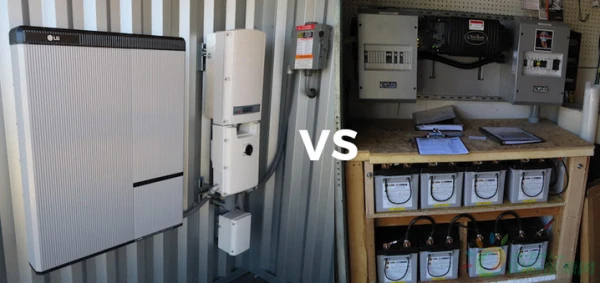
Lead-Acid Battery Applications
Lead-acid batteries have been used as backup power for residential solar power facilities since the 1970s. While they are similar to traditional automotive batteries, batteries used in residential energy storage systems are known as deep-cycle batteries because they are discharged and recharged more often than most automotive batteries.
Traditionally, lead-acid batteries cost less than lithium-ion batteries, which makes them more attractive to residential customers. However, they have a much shorter operating life than lithium-ion batteries.

Lead-acid batteries have a lower operating life than lithium-ion batteries. While some lead-acid battery cells can be charged and discharged up to 1,000 times, lithium-ion batteries can be charged and discharged between 1,000 and 4,000 times.
Most lead-acid batteries have a lifespan of about 5 years and come with a warranty. As a result, residential customers will have to replace lead-acid batteries several times over the overall life of the solar power facility.
Lead-acid batteries are less efficient at storing energy than other energy storage technologies such as lithium-ion batteries. Due to their lower efficiency, they also cannot be charged or discharged as quickly as lithium battery storage systems.
Lead-acid batteries have a low discharge capacity, which means that consuming too much energy can cause their ability to store energy to deteriorate quickly. A study by the National Renewable Energy Laboratory (NREL) found that releasing 50 percent of the energy in a lead-acid battery allows it to complete 1,800 charges and discharges before its storage capacity drops significantly. If discharged to 80% capacity, it can only withstand 600 charges and discharges, after which its capacity will drop significantly.
Lead-acid batteries require more storage capacity and space than lithium-ion batteries due to their relatively low storage efficiency and inability to discharge completely. Lead-acid batteries are also much heavier than lithium-ion batteries, requiring stronger supports to hold them and more space than lithium-ion battery packs.
Lead is a toxic heavy metal, and although it is recyclable, it can still cause pollution through improper disposal.
Lithium-ion Battery Applications
Lithium-ion batteries are fast becoming the battery of choice for many power applications, from cordless power tools to laptop computers and vehicles. An increasing number of residential solar power facilities are utilizing lithium-ion battery storage systems. However, lithium-ion batteries still have some limitations, the first and most important of which is their high cost.
Lithium-ion batteries have a higher upfront cost than lead-acid batteries. Tesla's Powerwall energy storage system sold for $5,900 or $6,600 in the U.S. in 2018, which includes supporting hardware. It's a 14kWh battery system that can deliver up to 7kW of power at peak demand. Its cost does not include installation costs, which typically range from $600 to $2,000.
However, the cost of lithium-ion batteries is falling rapidly. Over the past few years, the costs of various battery storage technologies have been evaluated in the Energy Storage Average Cost Analysis report. In its most recent survey, in November 2017, it found that the installed cost of a lead-acid battery energy storage system accompanying residential solar was $598 to $635 per kilowatt-hour. Installed costs for lithium-ion batteries ranged from $831 to $1,089 per kWh.
Based on these figures, the cost of a 14kWh lead-acid battery is as low as $8,372, while the equivalent capacity of a lithium-ion battery is as low as $11,634. However, the low cost of lead-acid batteries hides many other costs, such as shorter operating life and higher operating costs.
Over time, the cost of our battery systems will vary greatly. Surveys have shown that energy storage systems with lithium-ion batteries cost less per megawatt-hour than lead-acid batteries. Lead-acid battery systems cost $1,160 to $1,239 per megawatt-hour. This compares to a cost of $1,024 to $1,274 per megawatt-hour for a lithium-ion battery system.
The cost of lithium-ion batteries has also continued to decline, as found in another survey report. Lithium-ion batteries sold for as much as $1,000 per kilowatt-hour in 2010, with prices dropping by more than 20 percent in subsequent years. By the end of 2016, the average selling price of lithium-ion batteries was down $209 per kilowatt-hour.
However, an industry expert pointed out that these prices are mainly for batteries supplied by electric vehicle manufacturers. He says, "Due to much lower orders from developers of stationary energy storage systems, the cost of purchasing batteries is expected to be 51 percent higher than what automakers are paying."
For these reasons, it's important to understand the costs of lithium-ion and lead-acid batteries currently used in residential energy storage systems. They can be used either as stand-alone energy storage systems or in conjunction with residential solar power generation facilities to meet some or all of the energy needs of residential customers or businesses.
In terms of operating life, lithium-ion batteries are expected to continue to operate for approximately 10 years, and they are capable of charging and discharging to higher levels without significantly reducing capacity. The National Renewable Energy Laboratory (NREL) study assumes that the Tesla Powerwall can operate for 15 years without significant loss of energy storage and release, with 5,475 charges and discharges during that time.
Lithium-ion batteries also charge faster at higher voltages. While lead-acid batteries can take up to 16 hours to fully recharge, even the slowest-charging lithium-ion batteries can be fully charged in about four hours.
In terms of weight. Lithium-ion batteries used in residential energy storage systems are not light, but they are much lighter compared to lead-acid storage. The 13.5 kWh Tesla Powerwall weighs about 278 pounds, the 1.7 kWh lead-acid battery weighs about 132 pounds and a lead-acid battery with the same capacity as the Powerwall would weigh over 1,000 pounds.
In conclusion, lithium-ion batteries have advantages over lead-acid batteries for energy storage applications and will become more widely used in energy storage systems as costs come down.
|
|
|


Blue Carbon has a lot of experience in energy storage, up to 17 years of research in the energy storage industry, and very forward-looking lithium iron phosphate batteries for home energy storage. Blue Carbon's energy storage product development is mature, and the technology is more cutting-edge.
See more on energy storage batteries: